Demonstrating commitment to compassionate patient care, the health care team, & continued certification.

Maintain Certification

Maintaining NCCPA board certification signifies the ongoing commitment of PAs to meet established standards of clinical knowledge and cognitive skills throughout their careers. The 10-year certification maintenance process includes five two-year cycles during which all Board Certified PAs must earn and log 100 Continuing Medical Education (CME) credits and submit a certification maintenance fee by 11:59 p.m. PT, December 31 of their certification expiration year. In addition, PAs must pass the Physician Assistant National Recertifying Exam® (PANRE) or the Physician Assistant National Recertifying Exam-Longitudinal Assessment (PANRE-LA®) by the end of the 10th year of their certification maintenance cycle.

The two-year interval for earning and logging CME fosters PAs staying abreast of the fast-paced, ever-changing world of medicine. Passing a periodic recertification is one way that PAs can demonstrate they are maintaining the core medical knowledge deemed important for all PAs, regardless of their practice discipline. Extensive research supports a combination of these two elements for helping to identify knowledge gaps and retaining knowledge.

Visit the pages below to learn more about recertification options, (CME), how to regain certification, and more.

The recertification exam measures the core medical knowledge that is relevant for all clinically practicing PAs, regardless of their specialty or practice setting. Passing the exam helps PAs demonstrate they are staying up-to-date on core medical topics.

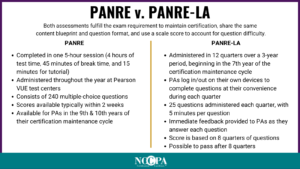
PAs now have two options for meeting their recertification exam requirement, and PAs should choose the option that best suits their individual preferences. Both exam options are based on the same content blueprint. With either option, PAs must also meet the Continuing Medical Education requirements. The fee is the same ($350) regardless of the option selected.

PANRE vs PANRE-LA

PANRE

About PANRE

PANRE is the traditional recertification exam that is administered in one setting at Pearson VUE test centers. You’re eligible to take PANRE in the 9th or 10th year of the certification maintenance cycle. Here are some highlights of the PANRE process.

  • You may take PANRE up to two times in the 9th year and up to three times in the 10th year, with a maximum of four total attempts.
  • You will be able to schedule your exam anytime (based on test center availability) within the 180-day timeframe established for you based on the submittal of a completed application.
  • PANRE consists of four blocks of 60 questions with 60 minutes to complete each block. There is a total of 45 minutes allotted for breaks between blocks and 15 minutes to view a tutorial. The testing time is four hours, and the total exam schedule is five hours.
  • It is administered throughout the year at over 200 Pearson VUE test centers in the U.S., as well as at select international centers, except for the last few weeks of the year. Visit our Key Dates webpage for exam administration windows.
  • You’ll need to take two forms of valid ID to the Pearson VUE test center and follow other security check-in procedures, as noted on NCCPA and Pearson VUE’s websites.
  • Exam security is a critical component of all NCCPA exams. More information about why and what measures NCCPA uses to ensure its exams are fair and valid can be found on our Exam Security webpage.
  • You will receive your results typically within two weeks of taking the exam. For information on PANRE scoring, click here.
  • You may only take PANRE once in any 90-day period. The 90-day limit on PANRE attempts is waived when (1) there are fewer than 90 days left in the 10th year and (2) you have not already exhausted all PANRE attempts for the year. In such cases, one final exam attempt is permitted.
  • You must also meet your CME requirements in addition to passing PANRE to maintain certification.

How do I apply for PANRE?

  • If you are in your 9th or 10th year of your certification maintenance cycle, just log in to your NCCPA Portal to register for PANRE. The registration fee is $350.
  • Visit our Key Dates webpage for exam administration windows.
  • You will receive an acknowledgment email that provides the 180-day testing window and instructions on how to schedule your exam with Pearson VUE.
  • If you apply late in the year to take the exam in the current year or late in your 10th year, your testing window will be shorter than 180 days.

What are the benefits of taking PANRE?

  • You will complete the exam in one 5-hour session.
  • You will receive your results typically within two weeks of taking the exam.
  • If you do not receive a passing score, you can retake the exam after waiting 90 days.

What are the exam dates for PANRE?

Click the button below to find exam administration dates for PANRE.

Physician Assistant National Recertifying Examination Longitudinal Assessment (PANRE-LA)

About PANRE-LA

PANRE-LA is an alternative to the traditional PANRE that was adopted following the two-year Pilot Alternative to PANRE. It incorporates elements of a longitudinal assessment and is designed to help PAs identify and address knowledge gaps in core medical content. Feedback from PAs who participated in the Pilot helped to inform the design of PANRE-LA. Here are some highlights of the assessment.

  • You can apply for the PANRE-LA in the 6th year of your cycle through the NCCPA Portal.
  • The exam is administered over 12 quarters in years 7-9 of your certification maintenance cycle, but you may finish as early as eight quarters.
  • Your final score will be based on your best eight quarters. You may work straight through or skip up to four quarters during the process, as long as you participate in at least one quarter in year seven and one quarter in year eight. Completing more quarters gives you more opportunities to pass.
  • Each quarter, you’ll receive 25 questions and will have five minutes to answer each question.
  • You can use printed or online references to help with the answer, if needed. However, you may not consult with others. Learn more about why exam security is a critical component of all NCCPA exams on our Exam Security webpage.
  • You will receive immediate feedback on each question you answer, including the correct response, explanation, and references.
  • Each quarter starting with the second, five topics are repeated to reinforce existing knowledge and facilitate learning. In these cases, the better of the two responses is counted and the other response is removed from the score.
  • Each quarter, you’ll receive feedback so you know how you are performing.
  • If you don’t pass by the end of the 12 quarters, you will have three attempts to take and pass PANRE in year 10 before your certification expires.
  • You must continue to meet your CME requirements while participating in the PANRE-LA.

How and when do I apply for PANRE-LA?

What are the benefits of taking PANRE-LA?

PANRE-LA may help remove some of the stress and anxiety of taking the recertification assessment, as it can be completed:

  • On your own device, whether it’s a phone, laptop, iPad, etc. – whatever you’re comfortable with!
  • On your own time. You can answer as few or as many questions as you want each time you log in during the quarter, as long as each set of 25 questions is completed by the quarter’s deadline.
  • From anywhere! As long as you have stable internet access, you can log in to answer questions using any of the supported browsers.
  • For every quarter that you answer all 25 questions, you will receive two Category 1 Self-Assessment CME credits (three credits with NCCPA’s 50% bonus for Self-Assessment).

Online Exams 

Examinations administered outside of a proctored testing center employ a variety of measures to ensure copywritten exam content is protected and no examinee is given an unfair advantage by accessing proprietary exam content. NCCPA collects and uses data collected from the exam software (e.g., response data, IP address) from existing information (i.e., information collected through an individual’s interactions with NCCPA), and information received from third parties to prevent, detect, investigate, and remediate exam-related misconduct, such as cheating, fraud, deception, or collusion among examinees.

For more information, please watch our exam security video: Click Here for Exam Security Video

Key Dates for PANRE-LA 

Visit our Key Dates webpage for application windows and quarterly start and dates.

Want more information about PANRE-LA?

Click the links below to download the PANRE-LA Resources. These resources include:  Fact Sheet, PANRE-LA blueprint, PANRE sample questions, Podcast, Tutorial, and a message from the NCCPA President and CEO on PANRE-LA.

PANRE-LA Volunteer Video

Experience the insights of our dedicated volunteers as they share their experiences in the “PANRE-LA Volunteer Video.” Hear firsthand from Board Certified PAs who make NCCPA’s mission possible.

Watch this PANRE-LA tutorial to give you an idea of what you can expect when you log in to answer questions.

Watch this video to learn how “repeat topics” in PANRE-LA can help you improve your overall performance and how the longitudinal assessment serves as a learning opportunity for those who participate in it.

This video addresses some of the most common questions we hear. Questions like “How is PANRE-LA scored? How will I know how I’m performing?”

PA-C Emeritus Designation

To honor those who have demonstrated longstanding commitment to lifelong learning, patient care and the certification process, NCCPA will confer the PA-C Emeritus® designation on eligible PAs who apply for the PA-C Emeritus designation, after the expiration of their NCCPA board certification. 

Eligibility Requirements for the PA-C Emeritus Designation

Board Certified PAs who apply for the PA-C Emeritus designation will be so designated following the expiration of their PA-C board certification provided they meet the following requirements:

  1. Document their retirement from clinical practice to the satisfaction of NCCPA;
  2. Have been certified by NCCPA at least 20 cumulative years during their PA career or document that they have retired from clinical practice due to permanent disability and have qualified for federal Social Security Disability Insurance benefits and/or disability retirement or long-term disability benefits (acceptable documentation is a statement, record or letter on official letterhead from one of the following: a treating physician/medical professional, a federal government agency which issues or provides disability benefits or a state vocational rehabilitation agency);
  3. Have no reportable actions in their NCCPA disciplinary history and no NCCPA disciplinary matter in any stage of review;
  4. Pay any fees associated with the PA-C Emeritus application process; and
  5. Fulfill other administrative requirements as shall be determined from time to time by NCCPA.

Maintenance Requirements for the PA-C Emeritus Designation

Like NCCPA board certification, the PA-C Emeritus designation shall be maintained on two-year, calendar year cycles.

Maintenance requires the completion of a reapplication process prior to the PA-C Emeritus designation expiration date, which will include attestation that the PA continues to meet the requirements established for initial eligibility. The PA-C Emeritus designation shall be suspended if the PA regains board certification and may be restored upon expiration of the regained certification if the PA meets the requirements for PA-C Emeritus status at that time.

PAs with the PA-C Emeritus designation must comply with all applicable provisions of the NCCPA Code of Conduct.

Limitations on Use of the PA-C Emeritus Designation

The PA-C Emeritus designation is not the equivalent of PA-C board certification. Those designated as PA-C Emeritus are not considered board certified by NCCPA and may not hold themselves out as such.

Further, the PA-C Emeritus designation may not be used in any clinical setting or in the context of any clinically related interaction, including clinical volunteer service.

Doing so – or committing any violation of the Code of Conduct or other act that would trigger NCCPA disciplinary review for Board Certified PAs — will result in review in accordance with NCCPA’s Policies and Procedures for PA Disciplinary Matters.

Sign in and go to “My Account” to apply.

Regaining Certification

PAs who have lost certification may regain it by fulfilling CME requirements, paying any outstanding fees, and passing PANRE

  • First sign in to your NCCPA Portal and log, or verify that you have logged, at least 100 Category 1 CME credits earned within the two-year period ending on the date your PANRE application is submitted to NCCPA. For example, if you plan on applying for PANRE on June 1, 2024, your CME earning window will be June 1, 2022-June 1, 2024. You can apply any CME credits that you have previously earned within the timeframe mentioned above.
  • Then apply for PANRE and, after receiving your exam acknowledgement email, schedule your exam as soon as you desire to take it following certification expiration. After that first attempt to regain certification, if unsuccessful on the exam you may take PANRE only one time in any single 90-day period.

Exception: PAs who have lost eligibility for certification due to NCCPA disciplinary proceedings must first apply to reestablish eligibility.

Next steps?

You can log your CME credits, apply and pay for the exam online at your personal record.

Certification Maintenance Resources

Access tools to help you maintain your certification

CME Audit FAQs

To ensure the accuracy and professionalism of CME logging and to strengthen the value of the PA-C, NCCPA randomly audits the Category 1 CME credits of Certified PAs. To complete the CME audit, randomly selected PAs must submit supporting documentation for at least 50 Category 1 credits logged during the cycle for which they are being audited.

PAs being audited are selected by a completely random process. There is nothing that you did or didn’t do that “caused” you to be selected for the audit.

NCCPA audits PAs for a two-year certification maintenance cycle. PAs chosen to be audited will be notified during the year after the PAs previous cycle has ended. A PA could be selected for the audit for up to an entire year after their previous cycle has ended. It is very important for PAs to keep their Category 1 documentation for at least one full year after their two-year certification maintenance cycle has ended. For example: PAs who were audited for the 2013-2015 cycle are notified in 2016.

PAs selected for the NCCPA CME Audit will be notified by the email address and the physical address that we have in your record. Please log into your PA Portal at https://portal.nccpa.net/signin/pa to ensure that your contact information is accurate.

NCCPA will provide you with a CME Audit Transcript that will list all Category 1 activities logged for the cycle being audited. This transcript will be included in the emailed and mailed notifications sent to you.

Six weeks is the standard amount of time allotted to submit your documentation for the audit. Your exact deadline will be listed in both the emailed and mailed notification correspondence sent to you and will be posted under your “CME” tab, which you can access by signing in to your personal certification record, https://portal.nccpa.net/signin/pa.

If you have a severe and extenuating circumstance which has prohibited you from providing the requested documentation in support of your Category 1 credits, you may request an extension to submit your documentation. NCCPA can grant a one-time only 30-day extension of your original audit deadline. Extensions for longer periods of time cannot be granted. To request an extension of your audit deadline, please submit a written request within the six-week period given to respond to the audit explaining your situation and include any supporting documentation you may have concerning your severe and extenuating circumstance. Requests must be received before the six-week deadline passes. This request can be mailed (12000 Findley Road, Suite 100, Johns Creek, GA 30097), faxed (678.417.8135) or emailed to [email protected]. Be sure to include your name and NCCPA identification number on the request.

If NCCPA has a valid email address on record, you will receive an official letter via email. If we do not have a valid email address on record, an official letter will be sent via postal mail to the mailing address we have on record for you. The letter will state your new audit deadline date.

Acceptable supporting documentation includes certificates received upon completion of an activity from the CME provider, a hospital-generated list of programs attended, or written verification of attendance or credits earned from the provider of a CME activity. Other documentation may be considered at the discretion of NCCPA. Acceptable documentation for Category 1 credits should state that the activity has been approved by one of our four CME sponsors (AMA, AAPA, AAFP, AOA, Royal College of Physicians and Surgeons of Canada (RCPSC), the College of Family Physicians of Canada (CFPC), or the Physician Assistant Certification Council of Canada (PACCC)). There should also be a statement indicating the number of Category 1 credits awarded for the individual activity. If the documentation you have for a Category 1 activity does not state this information, the activity cannot be considered Category 1 CME.

What is considered acceptable documentation for certificate programs like BLS, ACLS, or PALS?

NCCPA will accept a copy of the card you received, a certificate of attendance or written verification of attendance or credits earned from the provider of the certificate program.

In instances where the certificate shows the credits earned as “contact hours” or “CEU” credit, the certificate of completion accreditation statement will be thoroughly reviewed to determine Category 1 CME credit eligibility.

Please note: In most cases, NCCPA does not accept Category 1 CME credit for activities that award contact hours or CEU credit. However, these activities are approved for Category 2 CME credit.

“Confirmed” credits are Category 1 credits that NCCPA has received documentation for or Category 1 credits logged through the Conference Logging System. Since these credits have already been confirmed as Category 1, no additional supporting documentation is required.

Supporting documentation can be mailed (12000 Findley Road, Suite 100, Johns Creek, GA 30097), faxed (678.417.8135) or emailed to [email protected]. Be sure to include your name and NCCPA identification number on all materials.

It takes approximately 7-10 business days for NCCPA to complete an audit. Once your documentation has been reviewed, if we cannot verify at least 50 Category 1 credits, we will notify you via email (or telephone, if you do not have a valid email address on record). NOTE: It is strictly the PAs responsibility to check the status of their audit to ensure NCCPA has received the appropriate documentation.

Sign in to your NCCPA Portal at https://portal.nccpa.net/signin/pa and click on “CME” in the left-hand menu bar then choose “CME Audit Information”.

Yes. Additional Category 1 CME credits can be submitted to meet the audit requirements as long as the credits have not been previously logged to meet certification maintenance requirements and the credits were earned within the earning window of the cycle that is being audited. Acceptable documentation will have to be submitted in order to have these credits applied to the audited cycle.

PAs who are unable to submit supporting documentation for at least 50 Category 1 credits will fail the CME audit and will automatically be audited for their new cycle.

NCCPA will send an official email to you once your audit has been completed. If we do not have a valid email address, an official letter will be mailed to the address we have on record for you.

PAs who fail the audit because they reported Category 1 CME credits that could not be substantiated, that were erroneously reported as Category 1 activities, or that were incorrectly categorized as self-assessment or performance improvement CME will retain certification but will be audited again during the next two-year certification maintenance cycle and will be subject to the following additional requirements which must be completed prior to the expiration of their current two-year NCCPA certification including:

  1. Any Category 1 credits that could not be substantiated must be replaced with valid, appropriately-documented Category 1 credits.
  2. A Re-audit Fee must be paid.

In the second audit, PAs are required to submit appropriate documentation to NCCPA as they log their Category 1 and 2 CME credits. This documentation includes certificates of completion (for Category 1 CME credits), and all CME must be logged on an NCCPA paper logging form. If all required CME credits (including replacement credits) are not earned, logged and documented before the end of the certification expiration year, certification will lapse.

PAs who successfully maintain certification during the second audit, including completing the requirements specified above for the failed audit, will also be subject to an additional audit of their Category 1 credits in at least one of their next three certification maintenance cycles.

The CME Audit Detail Report is your audit transcript that shows which Category 1 credits have been verified by NCCPA and any discrepancies in activity information that was logged (i.e., incorrect sponsor, incorrect provider, incorrect activity name and/or date).

The 10-year certification maintenance cycle will include five, two-year CME cycles. Every two-year cycle, you will need to earn and log 100 CME credits, including 50 Category 1 credits. You will need to pass a recertification exam by the end of your 10th year, and you have two options for the recertification exam – PANRE-LA, which is an online exam, or PANRE, the proctored exam administered at Pearson VUE test centers. PAs who choose the PANRE-LA must apply for that exam in the 6th year and the exam is administered in years 7-9 of their recertification cycle. PAs who choose the PANRE option may apply and take that exam in years 9-10. Additional details on the recertification exams are provided in the recertification section of the FAQs.

Your CME credits should be earned and logged by 11:59 p.m. PT, December 31 of your certification expiration year along with submitting the certification maintenance fee. Sign in to your NCCPA Portal to view any outstanding requirements and upcoming deadlines.

NCCPA accepts Category 1 CME credit for activities designated by the AMA PRA Category 1 Credit from organizations accredited by the ACCME. Acceptable supporting documentation for Category 1 credits includes certificates, a hospital-generated list or transcript of CME activities attended, or written verification of attendance of credits earned from the accredited provider. The documentation should indicate the PA’s name, the name of the accredited ACCME organization, the title and date of the CME activity, and the number of credits designated for Category 1 Credit. If the documentation does not state this information, the CME activity should be logged as Category 2 CME.

Sign into your personal record and follow these instructions.

CME credits cannot be transferred from a closed cycle to a new cycle. If there is a special circumstance requiring the transfer of credits between cycles, a request must be sent to [email protected].

Credits earned on or after May 1 of your current certification expiration year can be transferred to the next cycle if both of the following conditions exist:

  1. Both cycles are currently open, and
  2. CME credits were completed on or after May 1st of the current year. For example, a PA who expires December 31, 2024, can log for both 2022 – 2024 and 2024 – 2026 cycles on and after May 1, 2024.

Taking a proctored NCCPA exam (i.e., PANCE, PANRE) does not qualify for Category 1 CME credit. However, you may claim your studying, preparation, and reading time for Category 2 CME credit.

The AAPA has approved participation in the PANRE-LA as a Category 1 Self-Assessment activity. For each quarter that you complete all 25 questions, you will receive 2 Category 1 Self-Assessment CME credits. For NCCPA certification maintenance requirements, NCCPA will automatically apply the 50% bonus for self-assessment activities, but keep in mind this bonus only applies to NCCPA CME requirements. Awarding CME credits for the PANRE-LA process recognizes the important element of learning that is incorporated into the longitudinal assessment format.

Simply log the exact number of credits earned according to your certificate with up to two decimal places (i.e., 1.75, 2.5, etc.)

The maximum number of Category 1 credits that you can earn as an instructor is included in the list of certification programs. However, you may only log those instructor credits once each year (or twice per logging cycle) regardless of how many times you actually teach the course. Additionally, duplicative instructing activities may be logged for Category 2 credit based on the number of hours spent preparing for and teaching the course.

The ATLS course does count for Category 1 (Preapproved) CME credit even though you did not receive a card or certificate for completing the course. You should have received a “letter of audit” indicating that you attended the course. If you are audited by NCCPA, the letter of audit (with a date listed) from the CME provider will be sufficient documentation of the activity.

You can earn Category 1 credit for delivering lectures to PA students or other medical professionals if the attendees receive documentation that the activity is approved for Category 1 credit. If the lecture was not preapproved for Category 1 credit, you can log time spent preparing for and delivering the lecture as Category 2 credit. Category 2 CME is earned on an hour-for-hour basis.

There are no maximums on the number of credits that you can earn for any Category 2 activity. All Category 2 credits are earned on an hour-for-hour basis.

The activity start and end dates are the dates the provider lists on the documentation as the date the activity began and ended.

Category 2 CME is any medically related activity that enhances the role of a PA (including journal reading). If you serve on committees at the local, state, or national level that meet those qualifications, you may log the time you spend on committee work for Category 2 credit.

CME earning windows always open on May 1. You can begin earning and logging CME credits for your next cycle on May 1 during the certification expiration year of your current cycle.

Sign in to your NCCPA Portal at https://portal.nccpa.net/signin/pa. Select the CME menu. Under the CME Details tab, select the appropriate CME Cycle Year to view the transcript. If you desire to print the transcript, select the Print button.

NCCPA provides the option to upload Category 1 CME documentation during the logging process; however, you should keep your Category 1 CME documentation for your current CME cycle and your last CME cycle in case you are audited and additional information is needed. For example, if you are currently on the 2023-2025 CME cycle, you need to keep that documentation and the 2021-2023 CME cycle documentation. NCCPA does not audit Category 2 CME.

Check with your state medical board regarding their individual auditing and documentation requirements.

Acceptable supporting documentation includes certificates received upon completion of an activity from the CME provider, a hospital-generated list of programs attended, or written verification of attendance or credits earned from the provider of a CME activity. Other documentation may be considered at the discretion of NCCPA. Acceptable documentation for Category 1 credits should state that the activity has been approved by one of our four CME sponsors (AMA, AAPA, AAFP, AOA, Royal College of Physicians and Surgeons of Canada (RCPSC), College of Family Physicians of Canada (CFPC), or Physician Assistant Certification Council of Canada (PACCC)). There should also be a statement indicating the number of Category 1 credits awarded for the individual activity. If the documentation you have for a Category 1 activity does not state this information, the activity cannot be considered Category 1 CME.

.

In instances where the certificate shows the credits earned as “contact hours” or “CEU” credit, the certificate of completion accreditation statement will be thoroughly reviewed to determine Category 1 CME credit eligibility.

Please note: In most cases, NCCPA does not accept Category 1 CME credit for activities that award contact hours or CEU credit. However, these activities are approved for Category 2 CME credit.

NCCPA will accept a copy of the card you received, a certificate of attendance, or written verification of attendance or credits earned from the provider of the certificate program.

Regaining Certification FAQs

PAs who have let their NCCPA certification lapse may regain it by fulfilling CME requirements and passing the proctored PANRE. PANRE-LA cannot be used to regain certification.

To be eligible to apply for PANRE to regain certification, you must first log at least 100 Category 1 CME credits earned within the two-year period ending on the date your PANRE application is submitted to NCCPA.

For example, if you plan on applying for PANRE on September 1, 2023, your CME earning window will be September 1, 2021 – September 1, 2023. You can apply any CME credits that you have previously earned within the timeframe mentioned above.

You will be eligible to apply for PANRE as soon as you meet the CME requirement (100 Category 1 CME earned within the two-year period ending on the date your PANRE application is received.)

PAs may take PANRE only one time in any single 90-day period.

There is no limit on the number of attempts to take PANRE for regaining certification.  However, the 100 Category 1 CME credits earned within the two-year period ending on the date your PANRE application requirement must be met for each exam application.

When you sign in to your NCCPA Portal, you will need to submit your projected exam application date. You will receive your CME earning window based on that projected application date. As you enter your CME credits, the system will calculate your credits and your dashboard will show the amount you have logged and how many are needed.

If you have met the CME requirement, the exam application link will be provided in your dashboard.